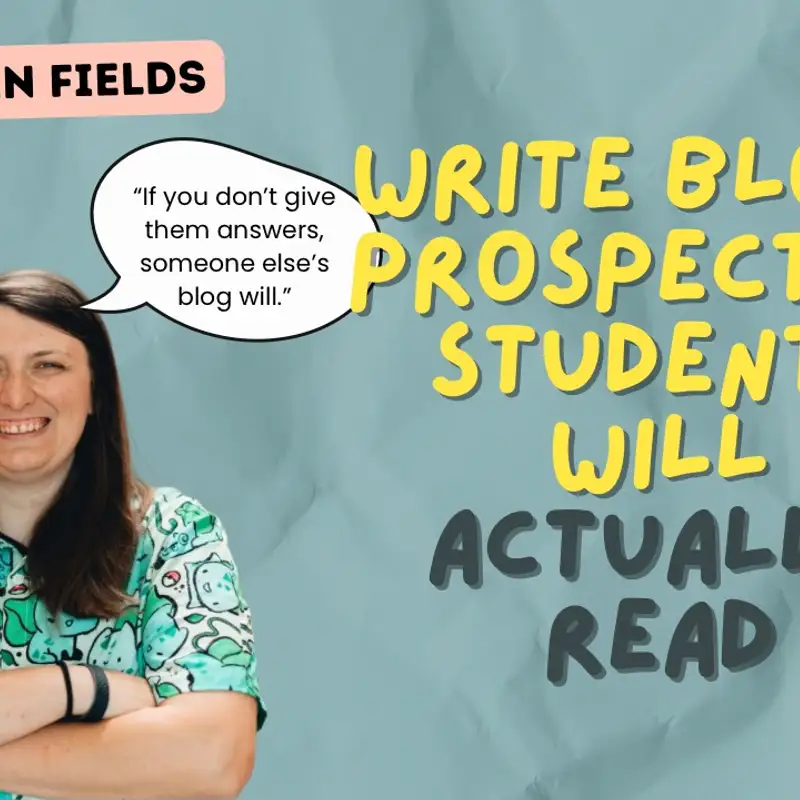
#99 - How to Write Blogs and Emails Prospective Students Might Actually Read w/ Erin Fields from Ologie
00;00;00;09 - 00;00;22;20
John Azoni
All right. My guest today is Aaron Fields. Aaron is the marketing director at ology. She leads the agency's content and thought leadership and spends her days helping higher ed sound less like a committee meeting and more like a conversation worth having, which. Aaron, bless your heart for that. We all appreciate it. A proud Marshall University and West Virginia University alumni.
00;00;22;20 - 00;00;28;18
John Azoni
She credits her Appalachian roots for keeping her grounded in honesty and heart. Welcome to the show, Aaron.
00;00;29;05 - 00;00;31;11
Erin Fields
Thanks, John. Thanks for having me. I appreciate it.
00;00;32;03 - 00;00;35;01
John Azoni
Yeah. So you have Appalachian roots. Where are the roots from?
00;00;35;17 - 00;00;51;19
Erin Fields
Yeah. So I am born and raised in West Virginia, and now I live in Kansas City. But, you know, I always think back about my home and how it shaped me. And, you know, I don't know if anybody else out there is from West Virginia, but believe me, whether I know you were not, we now have a tight bond.
00;00;51;20 - 00;00;52;24
Erin Fields
So if you're listening.
00;00;53;21 - 00;00;56;29
John Azoni
Go mountaineers and you all like John Denver, right?
00;00;57;01 - 00;00;58;20
Erin Fields
Oh, yeah. Country roads.
00;01;01;16 - 00;01;17;05
John Azoni
That's a good suck. Once in a while I'll just put on some, like, random, like yacht rock or like some, you know, like, like Hall of Notes or like John Denver. Just something that my parents would have listened to. And I'm like, Man, I feel like as you get older, the stuff just becomes like, super jammin.
00;01;17;20 - 00;01;21;08
Erin Fields
At this point. Yeah, it's quite literally our state anthem. Pretty much so.
00;01;22;28 - 00;01;30;24
John Azoni
Interesting. Okay, so, you know, we always start off on a tangent here. So what's what's something that people might be surprised to know about you?
00;01;31;18 - 00;01;55;17
Erin Fields
Oh, man. Okay. I'm sure some people are probably going to feel nostalgic about this based on like, especially if you're like, my age. People are usually surprised to find out that I play Pokemon cards, like in the competitive format. So it started as a nostalgia, a thing for me because I've loved Pokemon since I was a kid. But over the last few years it's really kind of became my main hobby.
00;01;55;27 - 00;02;13;11
Erin Fields
So I play locally at my local game store here in Kansas City, but I also travel for tournaments. So I was just in Milwaukee a few weeks ago and honestly, it's been such a fun community to be a part of and it's taken me to cities that honestly I probably wouldn't have gone to otherwise. So it was super fun.
00;02;13;11 - 00;02;23;08
Erin Fields
I loved Milwaukee and now I want to go back there more than just for Pokemon. So it's just something that people usually don't know about me and they're like, Oh, that's kind of nerdy, but that's also cool.
00;02;24;05 - 00;02;28;07
John Azoni
That is really cool. Are you like a grandmaster level?
00;02;28;17 - 00;02;30;17
Erin Fields
I wish I were because I.
00;02;30;17 - 00;02;30;21
John Azoni
Don't.
00;02;31;06 - 00;02;36;01
Erin Fields
I don't have the time to dedicate to be a grandmaster in Pokemon, but I wish I did.
00;02;36;14 - 00;02;54;10
John Azoni
I don't know anything about Pokemon, but I know that like there's, like some coveted like, cards. I equate it to like Pogs. When I was in like fifth grade, there were like certain Pogs that you'd want and you get the ones that were like glittery with like the POG character on it that was like you you're like jumping for joy.
00;02;54;10 - 00;02;57;16
John Azoni
Is there? What's what's like your favorite Pokemon card that you own?
00;02;58;10 - 00;03;16;07
Erin Fields
My favorite Pokemon card that I own. So my favorite Pokemon is called Metal Tank and it's like a little cow. So I don't I don't know why that's my favorite pokemon. It just is. But like, these tournaments are just like crazy. Like if you're not, involve the scene and like I told you that you there's like 3000 people at these tournaments.
00;03;16;07 - 00;03;28;12
Erin Fields
It's just like, whoa. Like someone outside thinks that kind of stuff is niche and it is. But like for something so niche to have 3000 people at a tournament, it's just like, Oh, okay, there's a lot of people that's interesting.
00;03;28;22 - 00;03;29;23
John Azoni
And yeah.
00;03;29;26 - 00;03;40;27
Erin Fields
It's crazy because like you have little kids playing, but then you also like I've played against people at tournaments and they're like 65 or 70 years old. Like, wow, it's Yeah, I know, right? It's crazy.
00;03;41;15 - 00;03;46;20
John Azoni
That's cool. I mean, they have like whole tournaments for, like people that do Rubik's Cubes, like really fast.
00;03;47;09 - 00;03;49;23
Erin Fields
There's a tournament for everything these days. Yeah, maybe.
00;03;49;28 - 00;04;05;18
John Azoni
Hobbyhorse jumping or whatever. That's my favorite. Like, I'm like, this is literally a tournament for people with a horse head on a stick pretending to ride a horse. And apparently some do it better than others.
00;04;05;18 - 00;04;10;11
Erin Fields
I now know my next hobby. I'm Jason. Great.
00;04;10;11 - 00;04;28;29
John Azoni
So you recently joined ology. You were at Roller Phi before that. You're joining us as part of our unofficial LinkedIn bangers series and you talk a lot about admissions related things, which I noticed. So give us a little history of, you know, kind of like your journey in higher ed.
00;04;29;22 - 00;04;58;04
Erin Fields
Yeah, so I post a lot about admissions because honestly, that's really where I built my foundation. My foundation originally, even though that my major in college was advertising, but right out of the gate I did not have a solely marketing job. It's always been admissions and recruitment. So before I joined ology and enroll of I in the past, my first job out of college was being a graduate assistant at the graduate admissions department at West Virginia University.
00;04;58;04 - 00;05;19;13
Erin Fields
And then I moved into a full time role in that department as well. And that experience, I feel like completely shaped how I think about marketing. Now, further on in my career. So I started on the front lines in that job. And so I was meeting with prospective students and I was answering their emails, I was giving presentations, I was doing campus tours, like I was hosting webinars.
00;05;19;13 - 00;05;34;23
Erin Fields
So I did like all of that front line stuff. And I was talking to people who are in all very different stages of life. So in grad school you have some people that they're going to grad school and they've just finished undergrad. You have some people who have maybe been out of school for ten plus years and they want to go back to school.
00;05;35;02 - 00;05;59;20
Erin Fields
We'd have international students who are trying to navigate a system that just like did not make any sense to them whatsoever, and they needed help going through that process. And so I think what really stuck with me was how inconsistent and confusing the higher ed experience was when I was talking with all of these people. And so, like, I remember talking to students and they didn't even know that you could fill out the fast offer for graduate school.
00;05;59;20 - 00;06;16;26
Erin Fields
They thought it was just an undergraduate thing. They just had no idea. And that's not even on them of not knowing. That's on us as higher education professionals for not creating content that actually beats people where they are. Right? And so I feel like that kind of work gave me a lot of empathy. I heard people's stories every day.
00;06;16;26 - 00;06;38;21
Erin Fields
Their career pivots, their doubts, their motivations, and it just really made me realize that higher ed marketing has to be personal. And you can't take a one size fits all approach to your audience that is that diverse. And so even though I've now moved out of admissions and I've crossed into agency life and agency work, I still carry that perspective with me every day, even though I'm doing the work that I am now.
00;06;38;21 - 00;06;48;01
Erin Fields
I'm always thinking about the other person on the other side. And that mindset really came from being in rooms with students, and I don't want to lose that no matter what audience I'm working with.
00;06;48;01 - 00;07;09;01
John Azoni
I love that. And you recently so you recently started getting pretty consistent on LinkedIn. I know there's a few people I mean, at least, you know, you know, decor builds and some others that ology that I kind of have their own like thought leadership, you know, brands going on LinkedIn from ology and you have joined the ranks. So tell me about your LinkedIn journey recently.
00;07;09;11 - 00;07;29;24
Erin Fields
The ology ranks. I love it. First shout out to my girl day. She's great. If you don't follow her on LinkedIn, you're missing out. She's also got a newsletter that's fantastic. But getting consistent on LinkedIn for me was really intentional. You know, I had been at this point in higher ed for a while and I've never not been in the higher ed sector in some way.
00;07;29;24 - 00;07;51;20
Erin Fields
Whether that's actually being in a university or that's not. I've always been connected to higher ed in some way. And so at this point in my career, I really felt like I had a seat at the table. And that came with the question of like, okay, well, what am I doing with the C now? And I knew that I wanted to build a platform and not just to share what I learned, but I feel like really to connect with other people that were doing the same work with me.
00;07;51;28 - 00;08;08;20
Erin Fields
And so I've all I've always valued learning from people that were ahead of me on an org chart, but also from peers. And then honestly, the folks that were earlier in their careers as well. I really believe that everyone has something to bring to the table and that learning should go in all directions no matter where you are in your career.
00;08;08;29 - 00;08;29;05
Erin Fields
And so I feel like that really pushed me to get active on LinkedIn because I was exposing myself to a lot of different people in my network. So for a long time I actually didn't post because I thought I needed to be a little bit further along in my career. Like, I don't know, I would think about my experiences, but then I would compare myself to someone else who's been in the field for a long time and I'd be like, Well, who am I to talk about this?
00;08;29;05 - 00;08;51;11
Erin Fields
Yet when I've only got, I don't know, like five years under my belt at that point or something. But eventually I kind of just realized I woke up one day and I was just like, You know what? Like, I don't need to have everything figured out to just contribute. There's a lot of value in sharing what you know, why you're still learning something and people seeing that kind of transparency of what you're learning.
00;08;51;19 - 00;09;15;21
Erin Fields
So I started posting more, especially thinking about reflecting on my time in admissions and the conversations that I used to have with students, something that I'm really passionate about, which we're going to get into this episode is just having authentic content that genuinely has value and builds trust. And funnily enough, like that's the stuff that really resonated with me, like the honest and transition moments that I experienced throughout my career.
00;09;16;03 - 00;09;37;05
Erin Fields
And so since then I feel like my LinkedIn has really become more than just a place to share ideas. But it's also helped me stay connected with people in the space I've met so many freaking smart and thoughtful people between marketers, creatives, admissions people, you know, all that are trying to make higher ed a better place and how can we learn from each other.
00;09;37;16 - 00;09;59;11
Erin Fields
And it really keeps me sharp. It forces me to really slow down and articulate what I'm seeing, what I'm reading, what I'm posting about, what I'm learning, what I'm thinking about, the work that I'm doing, which I feel like has made me better in my role at ology. To say, I mean, to sum all that up, I think LinkedIn really become a space where I want to go to become a learner and a peer and a contributor all at one time.
00;09;59;11 - 00;10;01;20
Erin Fields
And that's something that I want to keep showing up for.
00;10;02;17 - 00;10;24;22
John Azoni
That's great. And what I love about your posts is that you have a strong point of view, and that's my favorite people on LinkedIn to follow. And I feel like I say this every episode, but like there are not enough people that really understand how to use LinkedIn. I think they're still using it as like 2010 LinkedIn, where it's like a kind of a just a place to post your links to your blogs and say, Hey, go over here and check this out.
00;10;24;22 - 00;10;44;18
John Azoni
Or like, Hey, we're hiring. That's that's all fine. But I think like, you know, when you're a marketing director somewhere and you've got clients that you know, you know, like on the agency side that are kind of relying on you to have a point of view and how to guide them, I think really builds trust. I think it builds trust for the oLogy brand and it and it builds a sense of trust and security.
00;10;44;18 - 00;11;07;04
John Azoni
I think with people that work with you, it's like, okay, this person actually gets it and she has a way of doing things, a way of advising, in a way of thinking that, you know, is going to take. It's from A to Z. Mm hmm. At some point, I saw a major flood of your posts start coming into my feed, and I remember I was commenting like the first one, I was like, This is a bar.
00;11;08;20 - 00;11;22;02
John Azoni
And then the next one, it was like another bar, which in, you know, young people terms means this is good. You're dropping bars, you're dropping, you know, versus whatever. I don't know, rap culture.
00;11;22;02 - 00;11;41;17
Erin Fields
Yeah, that's that's so funny that you mentioned that. I, I remember that day. And then I remember not too long after that I had another one and you were like, this is a second bar. But it was just like it was like great to me because I had I had seen you obviously around the podcast. And so to me, you're someone in the industry that's also a trusted voice and so I was like, Oh, okay.
00;11;41;17 - 00;12;05;23
Erin Fields
Like my stuff is getting some kind of traction and resonance with people. And so it was great. But to your point, it's it's good to see LinkedIn. Like you said, people not using it for simply like, Hey, I got a new job or Hey, I'm looking for something. And not that people can't use it for that, but it's cool to see the evolution of LinkedIn even from, you know, five or ten years ago when people were only using it for those purposes.
00;12;06;05 - 00;12;20;05
John Azoni
Yeah, you know, we'll unpack the handful of your bangers here, but what was like the first posts where you realized people were starting to respond? Like what your efforts look like to be consistent? We're starting to work.
00;12;20;05 - 00;12;39;24
Erin Fields
That's a good question. I think the first post that I feel like really seemed to land was one where I said that university blogs have a bit of a weight problem. And what I meant by that was that you have blogs that like to be or institutions that like to say, you know, like we offer this or we believe this or we're proud of this.
00;12;39;24 - 00;13;01;11
Erin Fields
And so you start reading and it feels more like a press release than something an actual student would be searching or googling or chat greeting. And I think that one resonated because it was calling out something that I think a lot of people had noticed but maybe hadn't said out loud. And so it sparked some really good conversations about what it really means to write for students and not just internal stakeholders.
00;13;01;20 - 00;13;17;25
Erin Fields
But I'll be honest, sharing your voice online is a very humbling experience for every post that pops off like that one. There are others where it's just like, Yeah, you know, it's crickets and you kind of just hit post and you move on with your day. But I mean, like, that's part of it. You have to be okay with showing up in whatever way that looks like for you.
00;13;17;25 - 00;13;21;17
Erin Fields
And the important part is honestly just staying in rhythm and using your voice when it matters.
00;13;22;16 - 00;13;50;08
John Azoni
Yeah, for every, for every hit that I get, which is few and far between, there's a lot of duds. One I had a dud yesterday. I think I posted. I was like, I was like in the morning I was like, Oh, this is good. Like I'm process. This should get some legs and like, I'm not even joking. Zero engagement to the point where LinkedIn like, sent me one of those notifications that's like hey no one's engaging with your post here.
00;13;50;08 - 00;13;52;01
John Azoni
Do you want to maybe like text?
00;13;52;01 - 00;13;54;19
Erin Fields
Oh man, no way at LinkedIn.
00;13;54;28 - 00;14;19;05
John Azoni
So that's really so. So yeah, you know, it's a, an interaction of just do stuff and you know, don't worry about the results. The results will come, but the first banger here I want to unpack and I know we had a pre call and we, we talked about some specific ones, but then I was, you know, getting all of my thoughts together last night and writing out questions and I picked some new ones.
00;14;19;05 - 00;14;37;17
John Azoni
So hopefully you're prepared. Well, you wrote them so you should know, you should know what you're talking about. But the first one is and I'm going to read these because we'll put them in the show notes too, screenshots of these posts, but I'm going to read them for our listeners that are, you know, just doing the dishes or whatever in the background.
00;14;37;17 - 00;14;59;16
John Azoni
The first one is a college grad on Reddit, just solved their inbox problem by blocking every dot edu email domain in Gmail. That's how exhausted they were from the tidal wave of college marketing emails, most of which they never consented to. Sometimes outrage feels relentless. If your audience is literally blocking dot edu, it's no longer just a marketing issue.
00;14;59;16 - 00;15;20;17
John Azoni
It now begins a branding reputation issue as well. Respect. And you have some checkboxes here respect, inbox, space. Get permission, not just access. Make your messages worth receiving. Because of Gmail, filters don't block you. The students certainly will, and I like that. Okay, I'd like this for multiple reasons, but I want to start on reason number one. Do I like this?
00;15;20;17 - 00;15;37;06
John Azoni
Is that I see that you are active on Reddit, which I'm very encouraged by. So tell me about and we'll sidestep from the content of your post here and just talk about Reddit for for a second. BLOCK How are you utilizing Reddit? Because not a lot of colleges are tracking these threads.
00;15;37;28 - 00;16;07;01
Erin Fields
Yeah, I mean, I check our slash applying to college pretty regularly. There's a Reddit community or a subreddit community for pretty much like everything out there. And honestly, that's one of my favorite places to see what's trending, what students are actually saying. You're not getting a polished answer. That's honestly where I first saw the post about someone blocking every dot edu domain and gmail was our slash applying to college Reddit.
00;16;07;01 - 00;16;32;28
Erin Fields
I feel like it gives you this very blunt, very unfiltered view of specifically in that community what the application process actually feels like for students. So you can quickly see from, you know, students keyboards themselves what's confusing, what's overwhelming, what, you know, higher ed has thought that they've explained clearly in marketing what's, you know, still unclear very clearly what is unclear.
00;16;33;10 - 00;16;58;16
Erin Fields
So if you three read through enough of those threads, the messaging, messaging, exhaustion and decision fatigue is very obvious. Those are two very big trends I've seen in that thread. Specifically. And so there's just so much outrage and so much repetition and not enough clarity about what the student is supposed to do next. And we can think it's like, okay, you know, they're going here and they're going here, then they're doing this.
00;16;58;24 - 00;17;18;12
Erin Fields
Students aren't like that anymore. They're not doing things in a linear fashion. And I think we get too tied up in thinking that they do still do things in a linear fashion. And so, like, what's wild to me about Reddit is that most institutions aren't looking at Reddit or they don't think that check it, read it, and I'm usually not one of those people where I'm like, Well, if you're not on this, then you're missing out.
00;17;18;23 - 00;17;42;01
Erin Fields
If you're not on Reddit, you're missing out. Like genuinely, you were like having a focus group without having to moderate the focus group. And if you actually paid attention to it and did some research on Reddit about what is being said, I think higher ed would communicate very differently with the insights learned directly from people saying it in interacting with higher ed or your institution.
00;17;42;09 - 00;18;06;05
Erin Fields
There are subreddit communities specific for institutions. WVU has one. I've seen people on there talk about housing and dorms and scholarships and parking and campus safety. I mean, like those are all things that you can be using in your content. That's a goldmine that is coming directly from people who are interacting with your institution. So I don't honestly, I don't know why higher Ed is not using it more.
00;18;06;14 - 00;18;09;16
Erin Fields
It just it's a focus group that's literally right right there.
00;18;09;24 - 00;18;38;18
John Azoni
So yeah, and it's really the culture of Reddit is it's so anti commercial. So we're like if anyone sniffs out that you were, I don't know, like paid to write something, you know, positive for the brand or that you're, you're like the, the marketer, you know, the product manager that's representing the product that people are complaining about and you're trying to pretend like you're just part of the community, like, you know, people will sniff that out and like, downvote you like crazy.
00;18;38;18 - 00;19;09;11
John Azoni
Like, oh yeah, it's not. It's marketers and people trying to sell. Things are highly disliked on Reddit. So what that means is that you're going to get a very honest response from people. Like when I go look at, you know, I'm you know, if I'm going to buy something on Amazon and it's got like, you know, 505 star reviews, I'm even skeptical of the reviews that say verified purchase, because if you read how it's written, it's written in a way that's like for SEO, it's like.
00;19;09;11 - 00;19;11;22
Erin Fields
Oh, yeah, like something smells a little fishy there.
00;19;11;29 - 00;19;34;05
John Azoni
Yeah, it's written like when I bought the xt2 thousand five gigabyte something or other. I'm like, No one names the entire model like that in there, right? So there's a lot of places where you're going to get feedback that's thinly veiled. You're going to get a marketing plug that's thinly veiled as honest feedback. But Reddit, yeah, and there were were and.
00;19;34;14 - 00;19;57;22
Erin Fields
And you're going to get not good feedback or not good things from students. But then on the flip side of that, you're going to get things that people think you're doing. Well, they're also shout outs on their about like, Hey, this or like you've got don't plant influencers on Reddit. Let them do their own thing. But I've even seen students get in there and be like, Hey, you know, like this is happening at this time on campus.
00;19;57;22 - 00;20;24;20
Erin Fields
Who else is going or whatever? Like you've got people also speaking for you on there in ways that higher ed doesn't always need to inject itself As marketers, we don't always need to inject ourselves in these communities. You know what I mean? Like, there are things that we need to address that are happening in Reddit communities, but also like there are so many people on there that are influencers for your institution as well, and you need to take those nuggets and double down on the things that people think of your strengths as well.
00;20;24;20 - 00;20;28;07
Erin Fields
So it's like a two point on Reddit. You need to be actively listening for both things.
00;20;28;19 - 00;20;51;26
John Azoni
Yeah, so you got all these to back to the content of your post, you got all these colleges. So what made me think about this because back to the what you said about blocking all the ideas. Mm hmm. It made me think about, like, if a student's getting all these, like, emails for me to use that are irrelevant to them, I wonder how much of that is like cold email, like from schools that buy lists.
00;20;51;26 - 00;21;12;21
John Azoni
So if they're of a certain age now, they're getting this wave of colleges that have all bought their contact information and they're trying to set so like of course you're going to start blocking all the ideas. So I want to ask your opinion and maybe you have an opinion, maybe you don't. But I'm always just curious people's opinions about effective cold outreach.
00;21;12;26 - 00;21;21;24
John Azoni
Like how would you suggest we do this better? Let's assume this is cold outreach that is happening to this person. What what would be your first touch?
00;21;21;24 - 00;21;47;02
Erin Fields
Bluntly, I think in a way, cold emailing higher ed has just kind of gotten a little out of hand in terms of like, you know, again, this is I will plug around it again. This is something that I saw on that applying to college, read it. Someone takes the S.A.T., the A.C.T., whatever test it is, you know, when you send your test scores off to schools, usually you get that email, you get the student's email or whatever student goes through.
00;21;47;02 - 00;22;19;04
Erin Fields
They all four years of college, they pick a college. But the other schools still have that email. Four years later, that student is graduating and one of those schools is sending them an email about their graduate programs. Like to me, that is just very unnecessary. Like that's, that's spamming like that's I feel like cold email to an extent has been overengineered in the name of scale and attribution and I and not every email needs to be tailored down to name major zip code, but somehow it still feels like a mason.
00;22;19;13 - 00;22;37;02
Erin Fields
But I mean, like students feel all of that they're not impressed by personalization of the message doesn't actually help them. So to me, like I read that on Reddit and I'm like, why you know, like, why are you sending that email to someone who hasn't heard from you in four years? Like, of course you're going to get blocked.
00;22;37;06 - 00;22;58;21
Erin Fields
You haven't nurtured a relationship with that person. They haven't expressed further interest in your institution. Why are you not clearing the database from people like that? And maybe that's an easier said than done thing. And depending on your institution, I don't know. But if higher ed wants to do cold email better, it needs to start with better intent.
00;22;58;21 - 00;23;25;14
Erin Fields
And I think the goal of that first email isn't to convert. It needs to be to connect and it should feel like it's help and value. And you might be like, well, like. But, but, but like I've got my nursing program is ranked like top ten in U.S. News and World or whatever, and it's just like that doesn't fit into what they're actually searching for, looking for go at that point like it might be good information, but it's still spam if that's not the information that they're wanting and it's not valuable for them in that time.
00;23;25;29 - 00;23;49;27
Erin Fields
And so a better first touch in a cold email might be something simple, like, Hey, you know, like you're trying to figure out how to apply or when to apply for financial aid. Here's a quick guide that we put together on the fast food deadlines. You know, you have a list of students that have maybe like started or like clicked in to a specific web page on, you know, your website about your financing or you know, the fast or whatever it is.
00;23;50;07 - 00;24;13;28
Erin Fields
So like, you've got people who have shown intent that they're interested in that part of the journey, the student experience or whatever. So like, that's it. Like marketers don't marketers don't need to be that meme of that guy and the food just like what I keep picturing, like it's like surrounded by a bunch of different red strings trying to connect to like every possible dot to every possible data point about what they know about something.
00;24;14;08 - 00;24;39;14
Erin Fields
They just need to meet students where they are and give them the answer that they actually need when they need it. Because to me, if every email sounds like a sales pitch. Colleges and universities should not be surprised when students start tuning them out or, in this wild case, blocking an entire email domain of dot edu. The industry does not need more personalization in my opinion.
00;24;39;14 - 00;24;44;19
Erin Fields
It needs more permission and I think that starts by sending messages that are actually worth receiving.
00;24;45;14 - 00;24;46;03
John Azoni
Yeah, I mean.
00;24;46;13 - 00;24;48;00
Erin Fields
That was a big soapbox, so.
00;24;48;01 - 00;25;07;24
John Azoni
No, I love it. That's I love soapboxes around here. And I think to agree with what you're saying, like I think permission based marketing is so much stronger and so much more effective. And especially like if you can if that first touch is like, Hey, I'm going to give you some value here. Like high school students know, you know where to go.
00;25;08;02 - 00;25;29;23
John Azoni
You know, they're not going to be like, Wow, I got an email from, you know, such and such university that says they're the best. Like, I've tried. It's like it's like that scene and like else where he, like, walks into the coffee shop. He's like, Congratulations, like best coffee in the world or something. So but like, you know, what is it that students might be?
00;25;30;07 - 00;25;46;02
John Azoni
What questions might they be asking at that point that you can that you can answer? And then maybe it's like, hey, if you want more like this, we have a whole course or we have like, here, join this email list. We'll kind of help you through the college process even if you don't even come to our school, you know?
00;25;46;02 - 00;25;58;15
John Azoni
But something that builds trust more than just like, let me bother you until you until we, like, hopefully get you to click something and then maybe on some off chance end up applying.
00;25;59;02 - 00;25;59;29
Erin Fields
Yeah, right.
00;26;00;29 - 00;26;27;10
John Azoni
So your next couple of bangers here, you've got more than one about ineffective blogs and I like I like to these as well. Too many university blogs read like they were written to impress a VP, not help a student. Rolling admissions gets explained like clause in a contract. Campus safety is behind a wall of policies. Financial aid is a speech about access with out instructions on how to actually apply for university scholarships or FAFSA.
00;26;27;22 - 00;26;46;21
John Azoni
Most students just want to know, am I too late to apply? Will I be safe walking across campus at night? Can I even afford this? What do I actually need to do next? If you don't give them answers, someone else's blog will and they will apply there instead. So here's the move. Read your content out loud. Would you actually say this to a 17 year old who asked you a question with their parent?
00;26;46;21 - 00;27;12;29
John Azoni
Get it without reading it? If not, rewrite it less. We believe more. Here's how it works. I'm a big fan of this, this ideology of like not writing to impress the people that aren't your target audience. And it's just like rampant in higher ed where it's like, Who are you talking to with this? Where have you I mean, like, have you seen like examples of this, like going, you know, going wrong?
00;27;13;16 - 00;27;39;11
Erin Fields
I mean, not specific examples, but I think just like, you know, if if I think about the concept of how we know what students really want to know instead of just assuming those things, because it's very easy to assume. I think one of the biggest misconceptions about in all my social media folks out there, holla about social listening, is that it only happens on social media.
00;27;39;16 - 00;28;06;08
Erin Fields
And I get it's called social listening, but I really do like to call it active listening. Students aren't usually just broadcasting, you know, their questions publicly. You know, like sometimes they ask them in a DM, sometimes they ask things in the call centers, they ask things over emails, they ask things in info sessions. And I think those channels, they might feel quieter compared to something like social media or like Reddit we were talking about earlier.
00;28;06;16 - 00;28;48;02
Erin Fields
But they're still full of a lot of signals similarly to read it, and I think we miss a lot when we treat them like these one off interactions instead of patterns. And so I will get into another example later in the episode about an institution that I think does this well. But when I worked in graduate admissions, we were building content like how to apply for graduate assistant chefs or what's a fellowship because not that these things were high ranking SEO terms at the time because, you know, they weren't, but they, they were questions that we kept getting from students in our inboxes in social media, DMS over and over and over again.
00;28;48;02 - 00;29;11;10
Erin Fields
And we felt, you know, hey, we're if enough people are asking us these things, why don't we create some content strategy around it? And we did. And we made an entire guide called, you know, how to apply for graduate school at West Virginia University. And that was by far our most downloaded resource. And it was a step by step document on, you know, here's here's what you need to apply, here's how you get these things.
00;29;11;10 - 00;29;38;28
Erin Fields
How do you send official transcript? Can I apply without official transcripts? You know, what is the difference between an official and unofficial transcript? You know, like all these words that we throw around internally, students don't know the difference between an official and unofficial transcript more times than not. And we need to stop pretending like they do know those things and kind of like that's where it goes back to that thing of like, you know, we think that we communicate things clearly because we're in we're in the weeds of these things every day.
00;29;39;09 - 00;29;57;09
Erin Fields
Think about it without the tunnel vision for a second of, you know, take a first gen student who's never experienced the college process before. Maybe they don't know the difference between those things. And we need to be able to explain those things to them in a way that they understand and they feel empowered to be able to take that next step.
00;29;57;27 - 00;30;35;22
John Azoni
Yeah, it's really hard, though, to get out of that that tunnel vision of like, am I saying something in a way that makes sense to me and other people in my industry, or am I saying this in a way that other people are going to get? I think one of the conscious decisions that I made, you know, so videographer is actually a pretty pejorative term in in my in my industry, when people say videographer usually means like the guy, the old guy at the at the wedding with the old tape camera and he's like putting a camera on people's faces and asking them questions about the couple or something like old broadcast style that's kind
00;30;35;22 - 00;30;59;25
John Azoni
of like, like videographers hate being called videographers for that reason. And so that's why they're always like, I'm a filmmaker or like, whatever. And but like, the thing is, is like when colleges are looking for a videographer or looking to get a video done, they're not going to type. They're less likely to go into Googling like in higher ed filmmaker roles because they're not looking for a film.
00;30;59;27 - 00;31;05;08
John Azoni
They're looking for a they're not looking for some Steven Spielberg, you know, thing.
00;31;05;25 - 00;31;06;10
Erin Fields
Right?
00;31;06;10 - 00;31;28;29
John Azoni
So they're looking for they're most most often they're going to say a videographer and even like technically, I don't do a lot of the video a videographer thing. Like technically my role is I'm an executive producer, which which means that I build the teams that do the work. But like, still, again, no one's going to type in. I'm looking for a higher ed executive producer.
00;31;29;25 - 00;31;53;26
John Azoni
You know, it's a technical that makes but like to call myself a videographer is almost like it's weird for other people. It's weird for other people in the video industry because they would never call themselves that, but it's because they're all worried about what everyone else thinks. Yeah, and I saw this one guy speak out of the TED Talk or something like that, and I it's always stuck with me.
00;31;53;26 - 00;32;15;13
John Azoni
He's like, you know, you got these, like people that design chairs, for instance. He's like, they don't they don't design chairs for, like, how people's bodies actually work, like ergonomically designed chairs for chairs magazine. And so that they get so that they get, you know, and they get an award and all the chairs, people, you know, other chair miracles pat them on the back and and then off they go.
00;32;15;13 - 00;32;22;24
John Azoni
It's just that's just so often we're always thinking about the audience of our peers. So we write things.
00;32;23;00 - 00;32;24;15
Erin Fields
Mm hmm. Yeah.
00;32;25;02 - 00;32;53;10
John Azoni
So the other one that was sort of like the sister post to that to that one about university, Barack's written to impress the VP was Student Question What's it like to transfer here? University Blog Our institution is proud to announce a new strategic initiative around learner mobility. And I think that's that's super funny. I was just having a conversation with a friend the other day and she's in higher ed and she was telling me about it like they're launching like a course on like crisis communications.
00;32;53;22 - 00;33;17;04
John Azoni
And she was telling me about like she was kind of like lamenting, like what the marketing agency wanted to call it. And it was like some very convoluted, like, you know, strategic communications in, you know, leadership business, like something really, really heady. And I was like, you need to just call it like when shit hits the fan.
00;33;17;04 - 00;33;17;27
Erin Fields
101.
00;33;18;04 - 00;33;40;05
John Azoni
Yeah. And I'm like, And she's like, I wish I could call it that. But like, you know, the other people that are, you know, at the university would, it would not fly. I'm just like, man, like when did like, I don't know. I know you can't say like shit in a program title, but like, you know, like, why can't we name something, a nonacademic sounding thing that just makes sense?
00;33;40;05 - 00;34;03;03
John Azoni
Because, like, what if what if BuzzFeed were, like, writing headlines that were, like, so academic sounding, no one would click on them. The people click on the ones where it's like Britney Spears was doing a weird dance again, you know? Right. Poor Britney Spears. I have a big heart for her. Hope she's doing okay today. Yeah. What what do you think about that?
00;34;03;26 - 00;34;22;12
Erin Fields
I think it's it's so interesting, right? Because I was thinking about this the other day and I can't remember if this was something I actually posted or not. So my bad, I put I think about a lot of things and they just sent in my drafts and I'm like, Yeah, okay, yeah. I think about like higher ed and like the need to sound prestigious and I'm like, Why?
00;34;22;27 - 00;34;42;13
Erin Fields
Like because it's traditional. Because that's what tradition has said that we need to do. And I'm not saying that like higher ed needs to be like, Oh yeah, like, let's use the F bomb and essay chides. Yeah, I mean, like, no, that's a different thing. But you know, like, why are we so caught up in sounding so prestigious instead of sounding clear?
00;34;42;26 - 00;35;05;00
Erin Fields
And I think, you know, like, I think about those things and I asked myself, well, what's what is the solution to that? How do you even get by in to write effectively like that? And I think there's a case for clarity and to defend the outcome. If we want buy in to write more effectively than we have to show why a clearer version of something works better.
00;35;05;12 - 00;35;23;25
Erin Fields
And so instead of saying something just like, you know, I it's very vague to say, Hey, this is more conversational, this is how the kids talk, this is what the slings. I'm not saying anybody does that, but this is just like example, say something like, hey, you know, like students ask this exact this exact question. This version cuts the word out in half.
00;35;24;00 - 00;35;43;21
Erin Fields
We've tested both of these versions. We've a tested them. This one got three more clicks than the other one did. And so it's hard, especially for internal stakeholders to argue with results. And so when we bring stakeholders into real questions, we show them what students are actually asking in the emails or on Reddit or whatever. More times than not, they usually get it.
00;35;43;21 - 00;36;01;21
Erin Fields
They just haven't seen it from that angle before. You think about how what internal stakeholders are on top of their mind for them, and usually it's not something that a marketer in the weeds is working on that day. And so you have to be that person that gives a clear answer when someone's trying to make a hard decision.
00;36;01;21 - 00;36;19;19
Erin Fields
And that's what effective writing does. You have to step up to the plate and be that person of like, okay, here's what I'm saying. Because, you know, I think it was Seth O'Donnell that said this once. It's like, you know, you have to nobody's just going to give you a spot at the table. You have to make your spot at the table.
00;36;19;19 - 00;36;41;18
Erin Fields
And I've just love that for my career. And I think it's very applicable, especially for young marketers that are going from either, you know, entry level to mid-level or people like me that are going from mid-level to upper level positions. You have to fight for your seat at the table and like I said, make the case for clarity and defend the outcome that comes with that.
00;36;42;01 - 00;37;04;06
John Azoni
Yeah, yeah, absolutely. And we talked about we mentioned day capabilities earlier. I think it was her that said in one of her email courses, she was like, with your subject line, don't be cute, be clear. And yeah, I always like that about that because it's like when I look at like podcasts that I want to listen to or like when I go to listen to a podcast, it's usually a professional development thing.
00;37;04;06 - 00;37;06;21
John Azoni
I don't listen to a lot of podcasts just for entertainment.
00;37;07;00 - 00;37;07;15
Erin Fields
Me too.
00;37;07;29 - 00;37;27;09
John Azoni
So I'm kind of like, I want to know what is the problem this episode is going to solve for me? So when when the title is something that's like some lofty, like cutesy thing, that probably sounded good, but it's not clear like what it is. I'm trying. I can't even think of an example off the top my head, but like.
00;37;28;02 - 00;37;29;28
Erin Fields
Sounds like clickbait.
00;37;30;06 - 00;37;59;17
John Azoni
Yeah. Yeah. It's just like, well, I don't know what you're trying to tell me with this episode. So next. That's what I like with all that, with all our, you know, higher ed storytelling university episodes. Like I try to be really cognizant of like how we title them to be like, you know, because if you were to like, plug the transcript from this episode into JetBlue, it'll probably give you this like from this to that, the something, something, something of higher ed marketing.
00;37;59;17 - 00;38;10;18
John Azoni
And it's just like, well, like, just like say what it is. Just like, okay, so anyways, what school is doing blogging really well in higher ed, tell me what you've seen.
00;38;10;28 - 00;38;37;06
Erin Fields
Oh, man. Okay. From a WVU grad, you know, I got to give props and props are to the University of Pittsburgh admissions department phenomenal like it is one of the best examples and John, I can give you the link for this in the show notes. One of the best examples I've seen because of how they approach the whole idea of a blog for their school, you know, like I said earlier, I've seen a lot of blogs.
00;38;37;06 - 00;39;10;08
Erin Fields
They just treat it like PR, like it's a place to post achievements, kind of like LinkedIn, I guess promote programs like repackage, marketing, copy and longer form. But Pitt doesn't do like any of that. They treat their blog like a student support tool, and I feel like it really shows. And the topics are really practical too. So like those things I was talking about of, you know, things that you're hearing in a call center are things that you're hearing directly from students Have a few examples of posts that they've got on their website is, you know, what does rolling admissions mean?
00;39;10;11 - 00;39;28;21
Erin Fields
How do I apply for financial aid? And they're actually blog posts that are written to match the tone and the style of how students ask those questions. They don't take those questions and then like rebuttal them up and rewrap them as Christmas presents all nice and neat under a tree and say, okay, well, you asked this, but then here it is all buttoned up again.
00;39;29;15 - 00;39;48;25
Erin Fields
And I think it's interesting to see that shift from an echo jammed thought leadership piece to service. And I think that shift is really rare in the higher ed in the structure is really simple. The headlines are plain, the answers are very clear. Like we were talking about what podcast. It's very like to a point, this is what I'm learning from this.
00;39;49;07 - 00;40;14;19
Erin Fields
This is what I can expect to know from this. There's no really like story telling narrative, and then on top of it, it just gets to the point very quickly. And I think for the purpose of this admissions blog, that's exactly what it needs to be. And the result is that content really builds trust quietly. And it's not through something that might be quick, but it's through consistency and dedication and patience.
00;40;14;28 - 00;40;33;03
Erin Fields
And it really shows me that I don't think Pit is like trying to impress students with their brand voice. Like the temptation is there to do. They're just trying to be helpful for their audience and they're trying to be the department that a student needs. They're trying to put themselves in that shoe. And ironically, that's what makes them stand out.
00;40;33;20 - 00;40;43;08
Erin Fields
You know, you write about the things that people think are boring, like, oh, like rolling admissions. Like who cares? Who cares about that? Students care about that because they want to know what that means. And so I think I.
00;40;43;08 - 00;40;43;24
John Azoni
Don't know what that.
00;40;43;24 - 00;40;44;17
Erin Fields
Means. In other.
00;40;44;17 - 00;40;45;00
John Azoni
Words.
00;40;45;14 - 00;41;15;07
Erin Fields
In a world of overcomplicated content strategies, I think like pits refreshingly boring in a way. And I think that's what makes them brilliant. But to answer your question, like at WVU, we had different programs that were on, you know, we were a decentralized model at the graduate level, so we had different programs that had different deadlines. And so some have a strict deadline that you can submit your application to, but then others would have this rolling deadline where, like you could submit applications, like there was no hard set deadline.
00;41;15;07 - 00;41;17;00
Erin Fields
It was just always a rolling deadline.
00;41;17;22 - 00;41;23;10
John Azoni
Got it. All right. I don't have to go to you pits blog to find the answer. I'm going to go there.
00;41;23;16 - 00;41;26;01
Erin Fields
That I should have said. Check out the blog posts.
00;41;27;17 - 00;41;51;03
John Azoni
I'll go there anyway after after we hang up this call. But yeah, I think that's great because I think if we analyze our own viewing habits and reading habits, like I'm really big on building rabbit holes for our audience. And so if you think about like, would you go out of your way to go down a rabbit hole of press releases about anything?
00;41;51;06 - 00;42;12;17
John Azoni
It doesn't matter. You know, and any organization, any company, any college, like, would you just be like, Oh man, I can't wait to hear what they're doing right now. You know, that's why, like if you approach an email newsletter as an actual newsletter as like, news, a letter about news, it's a terrible idea. Like, nobody cares. Nobody wants to hear what you're up to.
00;42;12;17 - 00;42;37;11
John Azoni
And I get some of these in my inbox, honestly, from respected agencies in higher ed. And I'm kind of like, really? Like if this is a whole email about what you're up to today, like, what? What are you doing? You know, And it's but it's like, but when you build a library of what you're essentially doing, when you're building a blog, it's building a giant rabbit hole that that students can get lost in.
00;42;37;11 - 00;42;49;25
John Azoni
And and subconsciously they're just being imprinted with your brand on them because they remember you as the school that was really helpful. And you gave them an entire content library that could help them through this process.
00;42;50;18 - 00;43;14;16
Erin Fields
Yeah. And to your point about agency newsletters, like that's what I love about working in ology, and we have a monthly newsletter and we're very selective about what we put in that newsletter. If it's not valuable, if someone isn't learning something from a piece of content in that newsletter, it's not going in that newsletter. Every piece of content in our newsletter has value, and that's just that's just how we've always been.
00;43;14;27 - 00;43;16;05
Erin Fields
It's just what we've always valued.
00;43;16;16 - 00;43;30;25
John Azoni
Yeah, I love it. That's the way it should be. Okay, last one. I want to unpack is so this post is how many student spotlights are actually university talking points dressed up in hoodies. I thought I laughed at that.
00;43;30;25 - 00;43;31;24
Erin Fields
So true.
00;43;33;05 - 00;43;58;23
John Azoni
And how fast do prospects notice? So about 3 seconds they hit play the skim the caption spot the script before the logo intro fades. They get the usual suspects. I chose X for small classes professors who really care, a leadership title clued on for prestige and then I'm not. But I like your your solution. Here is swap polish for truth open with the wobble bombed by her exam.
00;43;58;23 - 00;44;27;08
John Azoni
The two a minimum I might transfer face time start where the stakes feel real and let the pivot breathe as point number two office hours roommate pep talk major switch show the messy middle not just the victory lap and then point number three and with the DM to freshman self tip one practical takeaway they'd they'd text their past self and so it's you highlighted this sort of format called struggle like struggle pivot payoff.
00;44;27;18 - 00;44;28;01
John Azoni
Mm hmm.
00;44;28;16 - 00;44;28;25
Erin Fields
Yeah.
00;44;29;01 - 00;44;44;04
John Azoni
So hey, this is very true. There's like so often it's just because when I'm scrolling Instagram, I will I can immediately tell if it's an ad, if they're like, Hey, business owners or something like that, if they call out the audience, I'm done. Like, Oh.
00;44;44;04 - 00;44;44;12
Erin Fields
Yeah.
00;44;44;20 - 00;45;02;20
John Azoni
I'm not listening to that. And that was advice from like ten years ago, like paid ads, Hey, you got to call out your audience so they, they know you're talking to them. That doesn't work with me at least, because people I follow don't talk like that. They're not like, Hey, video guy, you know, or something like that.
00;45;02;22 - 00;45;04;00
Erin Fields
Hey, videographer.
00;45;04;06 - 00;45;12;20
John Azoni
Yeah, videographers. But have you have you seen a good piece of higher ed content that followed this format?
00;45;13;12 - 00;45;35;25
Erin Fields
Yeah. So I mentioned at the beginning of the episode, I grew up in West Virginia. I'm a person, invited Marshall and to be Vue alum, and a few months ago I saw Marshall University in Huntington, West Virginia. They shared a story on Social and their blog actually about a student who had been homeless, battled addiction, dropped out of high school.
00;45;35;25 - 00;46;02;11
Erin Fields
And fast forward, he's now five years into recovery. He got his G.E.D., He stepped into a college campus for his first time in his thirties, and today he's getting ready to graduate with a degree in Social work. And he's already working as a peer mentor and he's helping other people work through recovery based on his experiences. And so to me, that's a fantastic example because that's a spotlight, because it follows a human arc.
00;46;02;20 - 00;46;03;01
John Azoni
Mm hmm.
00;46;03;12 - 00;46;34;28
Erin Fields
It doesn't open with, you know, I chose Marshall because I like the small classes or I'm one on one with my professor. You know what I mean? Like all these different things, it opens with a life that had been through such a real struggle. And so it doesn't just skip to the GPA and the accolades. It like I said, it sits in that messy middle and the uncertainty and the effort in the turning point and the payoff isn't just while he's graduating, it's he's using his own journey to help someone else.
00;46;35;06 - 00;46;58;01
Erin Fields
That's the full arc, the struggle, the pivot and the payoff. And so it's not a talking point. We're talking about a real person with a real journey. And so when prospective students, especially those who've had nontraditional paths, you know, they see that kind of story. It doesn't feel like a spotlight to them. It feels more of like, okay, like someone else has gone through this or someone else has had this hardship.
00;46;58;09 - 00;47;19;20
Erin Fields
And even if they don't relate to that entire story, you can pick pieces out of there. Maybe like, Oh, like I see myself in that. Or like, that's part of my story to and it feels like possibility. And so, like, why is higher ed not using these, these stories like that to be able to inspire people to make like we talk about access all the time.
00;47;20;02 - 00;47;41;23
Erin Fields
That's a perfect example of like someone who was against all the odds and they overcame it all and now are using that story to better other people and help other people. Like, that's an amazing story and I'm immensely proud to be an impartial alum after I mean, I'm always proud to be a marshall alum, but like finding those stories, they can be hard.
00;47;41;23 - 00;48;04;23
Erin Fields
It's not the easy way out of, you know, a typical story that we hear of, you know, someone you know, I didn't know where I wanted to go to college my senior year, and it was going towards the application deadline. And I just stepped on campus and it felt like home right when I was 18 years old. And I knew I was going to Marshall like, you got to dig for some of those stories.
00;48;04;28 - 00;48;10;10
Erin Fields
Yeah, because there's so much more out there than an 18 year old who stepped on a campus and it felt like home.
00;48;11;00 - 00;48;28;22
John Azoni
Yeah, And that's honestly and what I feel like is the biggest barrier because I think there's there's probably two barriers to creating content like that. I think that if someone has landed on this podcast and especially has made it this far in the episode, they probably aren't part of one of the barriers, which is can't wrap their head around.
00;48;28;22 - 00;48;48;01
John Azoni
Like not just saying the marketing speak is I think like, you know, the more I talk to people that kind of resonate with the content that I create, it's like because they get it. Like they're like, yes, storytelling has to be there has to be a story. There has to be like some struggle that's overcome some transformation. So I think most of our audience kind of like gets that.
00;48;48;07 - 00;49;13;00
John Azoni
But the problem that I see with almost every school that we work with is we're not collecting stories until they need them, and then by the time they need them, they're on a time crunch. So they're just they're just going with whatever some professor gave them, you know, And and these professors may or may not be having conversations that are going to get below the surface line with students.
00;49;13;00 - 00;49;41;13
John Azoni
But it does take some digging. You're not going to just get like, you know, look at a classroom full of people and go, who's got the best story here with that? You probably just going to go, well, who's got a cool internship? Who's, you know, trying really hard or something like that or, you know, I don't know. It's these these conversations that you have to have to, like, really dig to find out what's really the humanity behind this person and in the context for why they're here and, you know, what's their transformation like.
00;49;41;13 - 00;49;50;12
John Azoni
And I think we have to teach, you know, department heads and professors and stuff like what makes a good story? Like, what are we looking at here? Mm.
00;49;51;12 - 00;49;52;06
Erin Fields
Good questions.
00;49;52;22 - 00;50;03;09
John Azoni
Yeah. So this was one question I was curious to ask you is if you were to apply this advice to your own story from your alma mater, what would be that struggle or pivot payoff for you?
00;50;03;22 - 00;50;05;25
Erin Fields
Well, be warned me about this question.
00;50;05;25 - 00;50;09;06
John Azoni
So I did.
00;50;09;06 - 00;50;29;21
Erin Fields
So I was trying to think of like an I don't have anything that's like super like story breaking. Like the example I just shared for Marshall. But I was thinking in, you know, like I started college as a sports journalism major, and that was mostly because I liked sports a lot. I've always played sports. I've always watch sports.
00;50;29;21 - 00;50;55;23
Erin Fields
I've always been like sports. I love sports and I like writing. So, like, you know, like that sounded like a pretty solid path, even though, like, I didn't have a real plan. I was kind of just like, Yeah, I'm going to be on, you know, the sidelines one day on ESPN and that's going to be my life. And pretty early on I realized actually that that schedule wasn't going to work or that major wasn't going to work if I wanted to stay in marching band all four years.
00;50;56;07 - 00;51;14;27
Erin Fields
And so that was something at the time that I really cared about, like if I had a personality at that point it was sports and marching band. So in a very freshman ear logic kind of way, I switched my major to advertising like a snap. Like I had this revelation. I went the next day to my advisor and I was like, Hey, I'm switching.
00;51;15;09 - 00;51;41;19
Erin Fields
I didn't have any background in advertising or marketing. I didn't have any like big career epiphany of like, this is what I want to do. I just knew that like I wanted a major that gave me a little bit more room personally. And so like somehow that decision on a whim ended up being like the best decision that like I could have made because I absolutely fell in love with my major with the project.
00;51;41;19 - 00;51;59;22
Erin Fields
So I got to work on the people that I got to learn from the way that even you know, my major in advertising challenged me creatively and it became one of those things where like, I loved it. Then once I got started working on things and I still love my career now, and that's something that I feel like is very special to me in my life.
00;51;59;22 - 00;52;21;23
Erin Fields
Like truly, I could not picture myself doing anything else other than what I do now. I love my current job and I love my career, and ology is just like one of the best places to work. Like I'm going to shamelessly plug ology that just like it's truly an amazing company with amazing people. And I feel like God's like really blessed me with the path that I could have never mapped out on my own.
00;52;21;23 - 00;52;43;06
Erin Fields
But I'm very grateful for this path. But like the best part in all of that is that, you know, I say that I changed my major from sports to advertising because I wanted to keep music a part of my life. And so my internship actually ended up doing social media for the entire martial music department. And so even the marching band part worked out of all of that story.
00;52;43;06 - 00;52;57;14
Erin Fields
So I know that's not like super like pivot and pay off, but I do think that's like a little special story to me of like, okay, like I didn't know what I was doing in that moment. Like, truly, and I just kind of like ran on a whim and it somehow worked out. I don't.
00;52;57;14 - 00;53;14;28
John Azoni
Know. Yeah, I think that's a great story in like, I think we put too much pressure on like the drunk dramatic stories like I lost both my legs and both of my arms and I had to roll my way onto campus or something like.
00;53;14;28 - 00;53;16;03
Erin Fields
Yeah, that's a good point.
00;53;16;06 - 00;53;29;24
John Azoni
You know, it's like it's sometimes it's, you know, we need, you know, stories that the majority of people can, you know, relate to. But that was just such a dumb example.
00;53;30;15 - 00;53;32;21
Erin Fields
Of some part staying in the episode.
00;53;33;14 - 00;53;34;05
John Azoni
Well, keep it in.
00;53;36;07 - 00;53;57;28
John Azoni
But but but I think that, you know, the reality is like a lot of people don't you know, they enter college not knowing what they want to do and they hope they just kind of stumble through it and find their way. And and to hear, you know, a story of someone like them that because, you know, kind of picked a major and it ended up working out.
00;53;57;28 - 00;54;07;21
John Azoni
I think that's, you know, really great, great news. You know, and also to hear from someone that actually is using their major in their entire career.
00;54;07;21 - 00;54;24;12
Erin Fields
Yeah. I mean, that's just like crazy to me. Like, I look back and I'm just like, wow, I really switched my major because I wanted to do marching band. And I'm like, What kind of reason is that? And now I look back and I'm like, Oh, thank goodness I made that. Like, not that I wouldn't have succeeded in sports journalism, but there's no way I would have loved my job like I love sport.
00;54;24;12 - 00;54;30;26
Erin Fields
I love sports so much that it's just like I didn't want that to be my career. And then I ended up finding a career that I loved anyway.
00;54;30;26 - 00;54;49;23
John Azoni
So yeah, but the thing is, like, there is stakes in that story, you know? That's why it's a story worth listening to because like, I think people can relate to, like what happens if I choose this major and it's wrong, you know? Right. So and I think that's the more important part in when colleges collect stories is like, is there any stakes here?
00;54;49;23 - 00;54;52;20
John Azoni
Is there any reason to keep watching and see what happens?
00;54;53;28 - 00;54;54;14
Erin Fields
Right.
00;54;54;14 - 00;55;17;03
John Azoni
And that, I think, is as important, if not more important than some dramatic thing, you know, some dramatic from to kind of story. Mm hmm. For sure. Okay. So we've had a great conversation, but I'd love for you to just kind of, like, put a bow on it for us. What would be your final, you know, word of wisdom to our listeners that kind of sums up our conversation here.
00;55;17;16 - 00;55;37;13
Erin Fields
Sure. I think if I can leave folks with one thing and one thing only. Thank you. Don't have to overhaul everything to make better content, but you do have to give yourself permission to try something different. So much I feel like of higher ed is in defense mode of what will legal say? What will my dean think? What if it doesn't work?
00;55;37;13 - 00;55;55;05
Erin Fields
And what if like you know, I mean, like I get it. There's a lot of eyes, there's a lot of layers. There's a lot of pressures to play it safe. But some of the best ideas that I've seen didn't start with a brainstorm. They just started with pure curiosity, with someone just saying like, you know what? If we tried this, right?
00;55;55;05 - 00;56;15;17
Erin Fields
What if what if you did? What if you wrote the email like you were having a one on one coffee conversation with someone? What if you had a student story that started with failure? What if your blog post skipped the headline and just gave them the answer? You know, like those small experiments I feel like are where trust is built and really where innovation starts.
00;56;15;17 - 00;56;33;16
Erin Fields
And so, like, you don't need a full rebrand or a full overhaul. You just have to give yourself some room to be brave. And so if nothing else, give yourself the permission to make the thing that you would want to read, because that's usually the one that works the best.
00;56;34;02 - 00;56;50;02
John Azoni
Love It bars. US from Aaron. Great talking with your listeners. Go follow Erin on LinkedIn. She's got I'm sure more bangers to come Aaron Field spelled just like it sounds. Is there any anywhere else where you'd like people to connect with?
00;56;50;02 - 00;57;03;17
Erin Fields
You know, LinkedIn is pretty much my main platform. Feel free to connect with me, network with me, let me know. And John, what you thought about the episode. If you want to continue the conversation, I'm always happy to chat, so feel free to shoot me a message.
00;57;04;08 - 00;57;09;00
John Azoni
Absolutely, Ali. All right. Well, thanks so much for being here. This is a really great conversation, so we're glad to have you.
00;57;09;12 - 00;57;10;17
Erin Fields
Thanks, John. Appreciate your.